


About Korea. IL2 Series: F-84E Thunderjet Collectors Plane
Development and Production
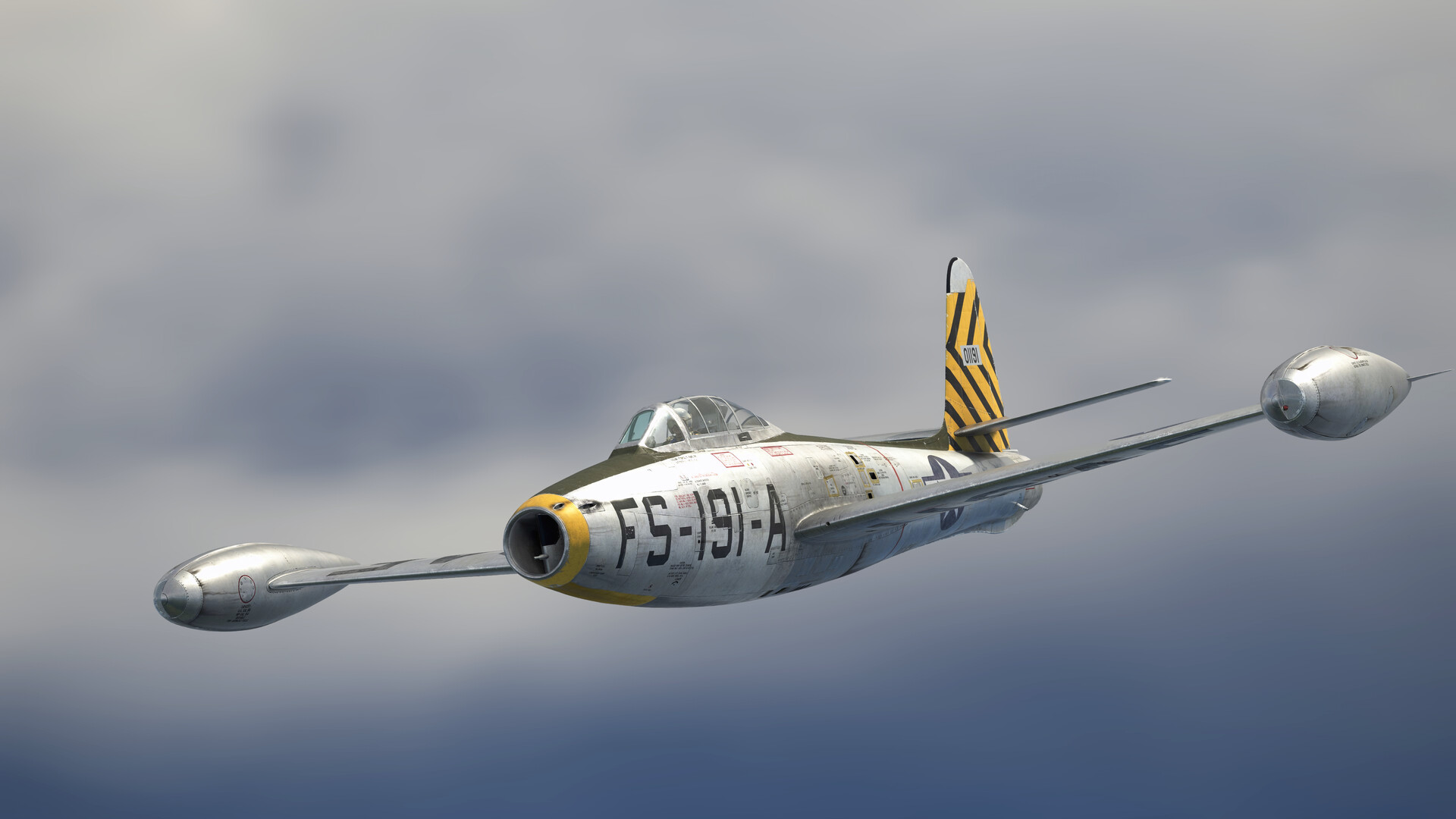
The American F-84 jet fighter was designed starting in 1944 at the design bureau of the Republic Aviation company under the direction of A. Kartveli as a long-range fighter escort for bombers. The first prototype, the XP-84, first took to the air on February 28, 1946. The first pre-production YP-84A rolled out of the factory in February 1947, and in 1948, the P-84 designation was changed to F-84. In 1949, production of the F-84E modification began, based on which the F-84G fighter-bomber and carrier of tactical nuclear weapons was later built. Production of the Thunderjet variants ended in July 1953, with a total of 4,455 aircraft built, including 843 F-84Es.
The first production F-84s entered service with the 14th Fighter Group in the summer of 1947. Operation of the aircraft in combat units revealed many shortcomings, which is why the first modifications of the F-84 received the nicknames "Mechanic's Nightmare" and "Pilot's Nightmare." At the height of serial production, numerous flight accidents forced the Air Force to stop flying all aircraft of this type and to carry out modifications to the delivered machines. The identified deficiencies were corrected on the F-84E model. It became the first large-scale modification of the aircraft that fully met the requirements of the US Air Force.
Service
With the outbreak of the Korean War, the US high command, expecting the outbreak of World War III, was in no hurry to transfer modern aircraft to the front. However, the appearance of modern jet fighters in the enemy's hands forced the newest aircraft to be sent to Korea. The 27th Fighter-Escort Wing was also sent to Korea with F-84Es. These aircraft made their first combat sorties in late December 1950, escorting B-29 bombers on daylight raids. On January 21, 1951, the first battle between the F-84 and the MiG-15 took place. Two pairs of F-84s, attempting to bomb a bridge over the Han River, were attacked by six MiG-15 fighters from the 177th Fighter Aviation Regiment. Two Thunderjets were shot down. On November 30, 1951, 89 F-84s, escorting 21 B-29 bombers in a raid on Nancy, were unable to protect them from attacks by 44 MiG-15 fighters. 12 B-29s were lost, and the bombing raid was thwarted. According to American data, the enemy lost 7 MiGs. The actual losses amounted to one MiG-15.
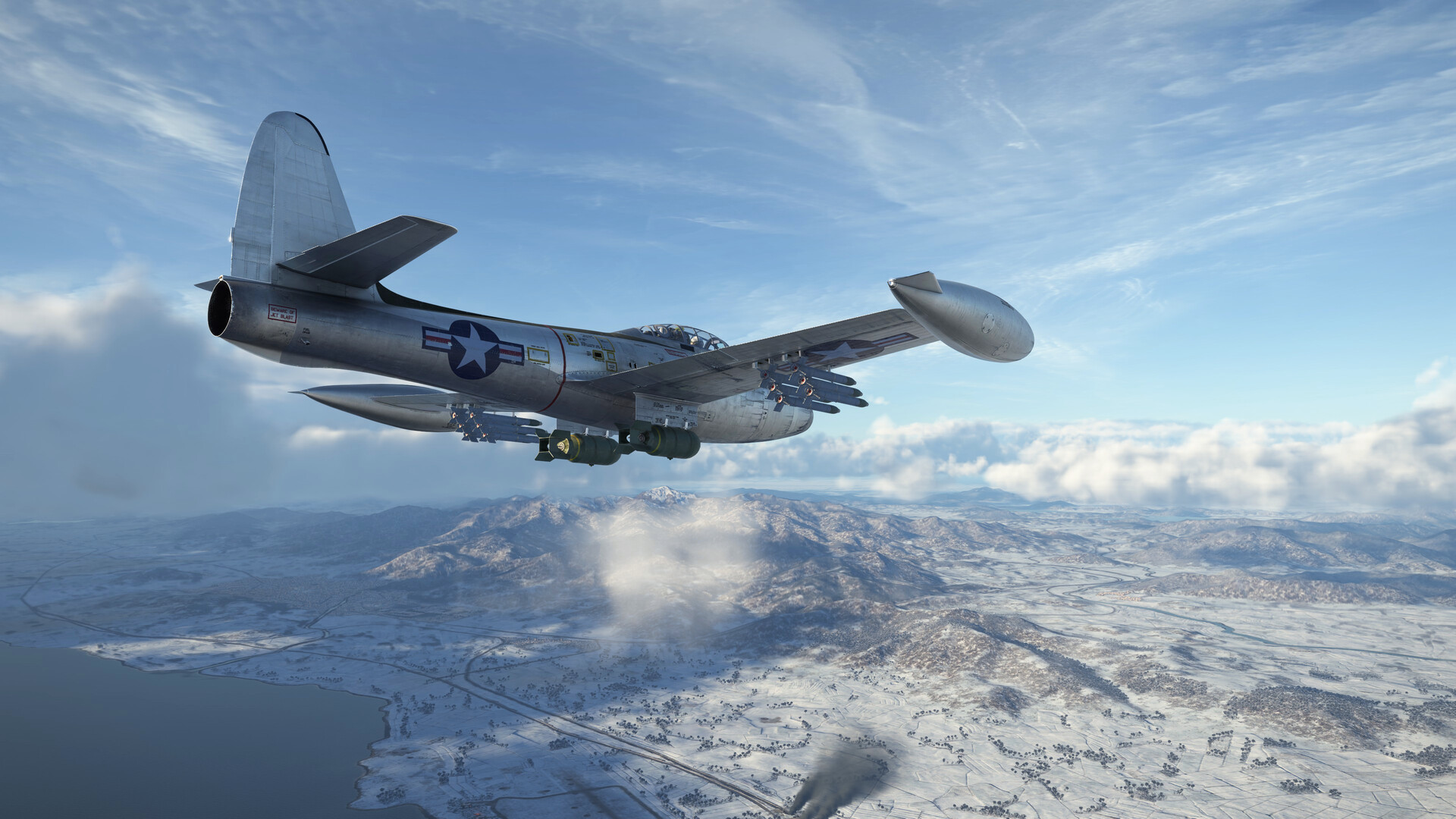
Based on the experience of air combat, it became clear that the F-84E was not capable of fighting the MiG-15 on equal terms. However, the F-84's range, speed, and payload made it suitable for use as a fighter-bomber. At the end of June 1951, the 136th Fighter-Bomber Group, formed based on three squadrons of the Air National Guard and equipped with F-84Es, entered the battle. On September 19, 1951, the 49th Fighter-Bomber Group, which had previously flown the F-80, began to fly the F-84E. Thus, at the end of 1951, the F-84Es were retasked as attack aircraft operating near the front line. By the end of the war, they were also used to strike remote industrial targets, using aerial refueling.
During the war, Thunderjets carried out 86,408 combat sorties, dropped 50,427 tons of bombs and 5,560 tons of napalm, and fired 5,560 rockets. F-84s carried out 10,673 strikes on railroads and 1,366 on highways. According to official American data, during this period, F-84 pilots destroyed 8 MiG-15s and 1 Yak in air combat.
Structurally, the F-84E is an all-metal mid-wing aircraft with a straight laminar-flow wing, an air intake in the forward part of the fuselage, and a retractable tricycle landing gear.
Design Features and Armament
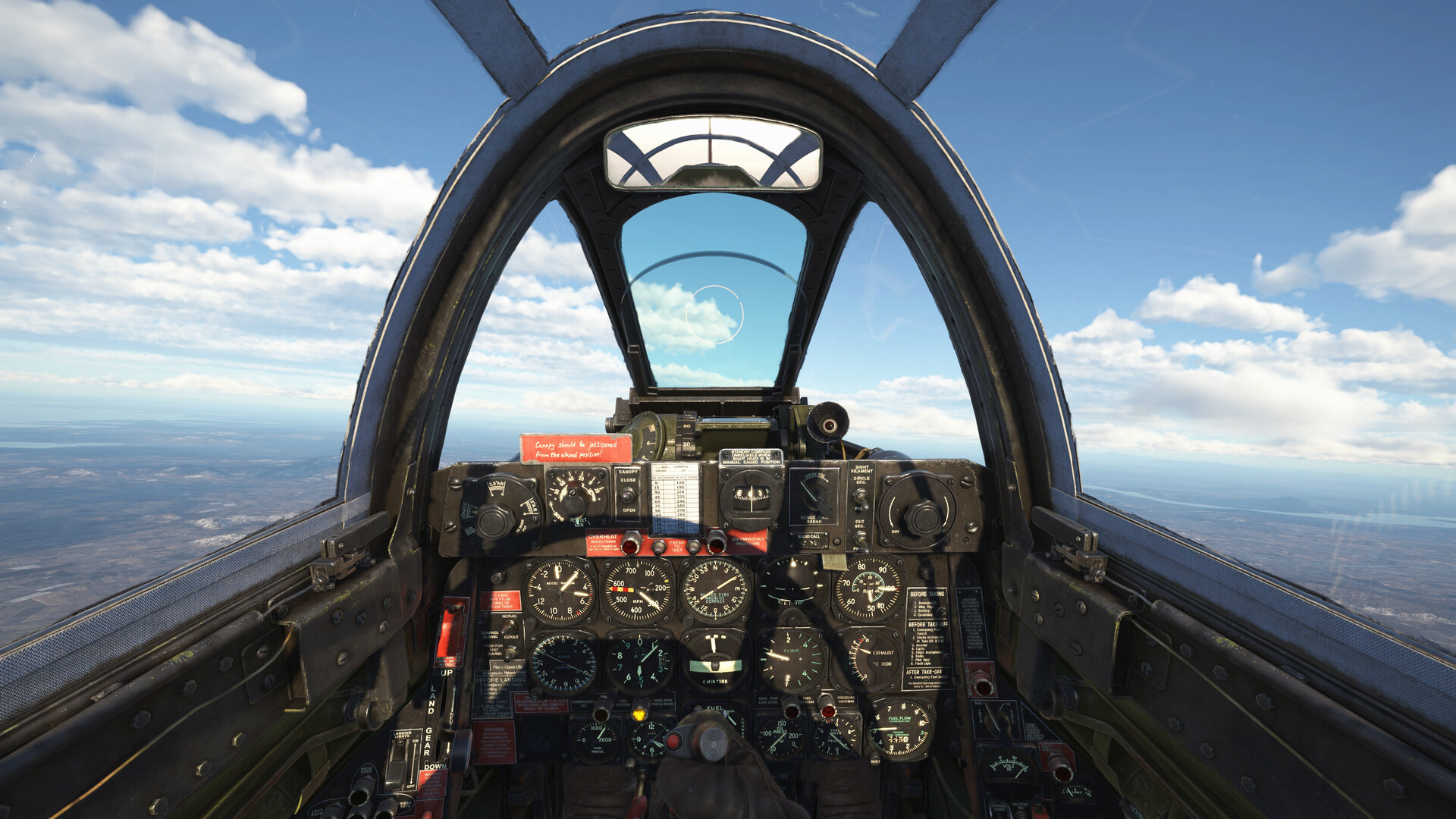
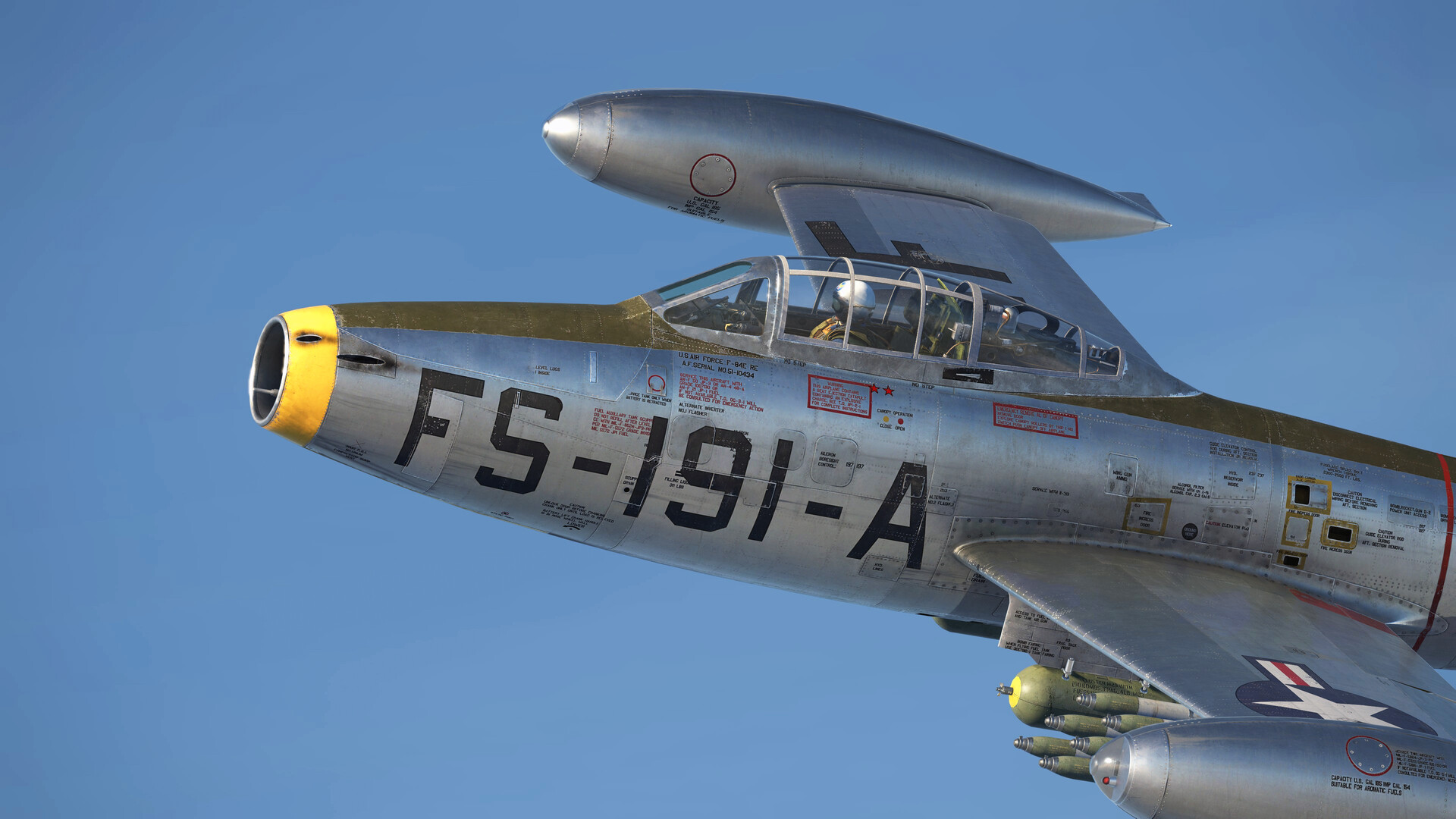
The fuselage of the aircraft is circular in cross-section. Structurally, it consists of three sections: nose, middle, and tail. The nose section houses the air intake with a transverse vertical partition, the nose landing gear, part of the armament (4 machine guns), and electronic equipment units. The middle section houses the cockpit, wing attachment points, and three fuel tanks. On the lower surface of the middle section, there is a perforated brake shield controlled by two hydraulic cylinders. The cockpit is pressurized and equipped with an ejection seat. The canopy is teardrop-shaped and slides. Air taken from the engine compressor is used to heat the cabin in flight.
The tail section houses the turbojet engine. The tail unit is attached to it, and the lower part contains removable suspension units for the rocket boosters.
The F-84E has a straight wing with a constant relative thickness along its entire span. It is attached to the fuselage with bolts. The wing mechanization includes slotted flaps and ailerons. The ailerons have a booster. The internal volume of the wing is occupied by fuel tanks. Also, two large-caliber machine guns were installed in the wing roots.
The aircraft has a retractable tricycle landing gear with a nose wheel. The main landing gear retracts into the wing, and like the nose gear, it shortens during retraction. The shortening system is mechanical. The nosewheel is unsteerable; turns during taxiing are achieved by breaking the corresponding main wheels.
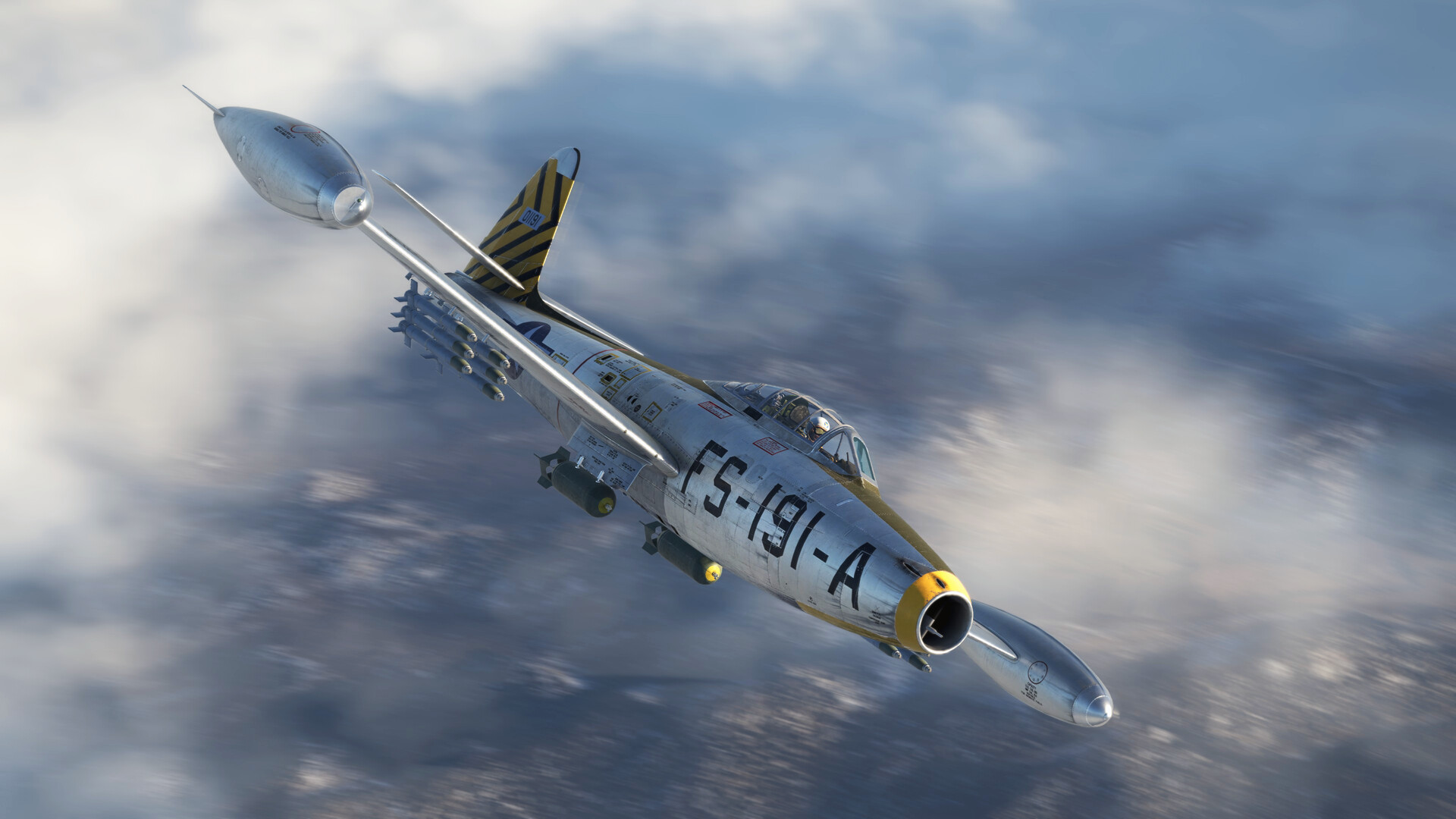
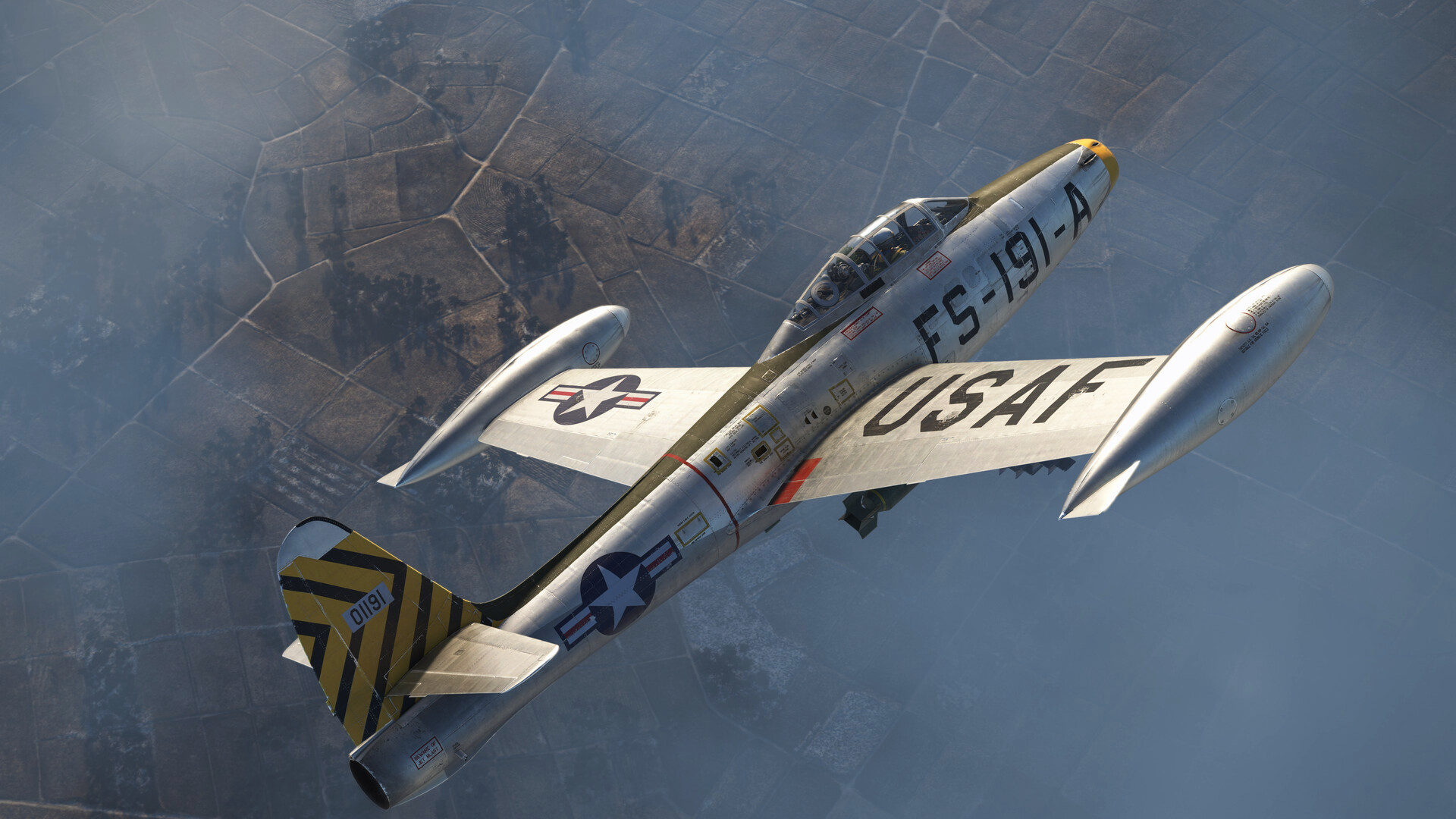
The power plant includes an Allison J35-A-17B turbojet engine with an axial compressor installed in the tail section of the fuselage. The fuel system consists of 3 fuselage and wing fuel tanks. Additional fuel tanks can be installed on the wingtips, which can be jettisoned in an emergency. The F-84E can also carry two external fuel tanks suspended on two central pylons. In addition, a certain number of F-84Es were equipped with an in-flight refueling system, with two fuel receiving rods (left and right) located in the nose of each of the tip tanks. The capacity of the wing and fuselage fuel tanks is 1,516 liters; the total fuel supply with two 817-liter tanks on the wingtips is 3,150 liters.
The elevator control system consists of rigid rods and cables, the rudder — cables, and the ailerons — rigid rods with a booster amplifier. The hydraulic system provides for the release of the landing gear, brake control, release of the brake flaps, and operation of the aileron booster. There is a fire warning and suppression system.
The aircraft was equipped with radio equipment, including an AN/ARC-3 radio set, an AN/APN-6 radio compass, and an AN/APX-6 identification system.
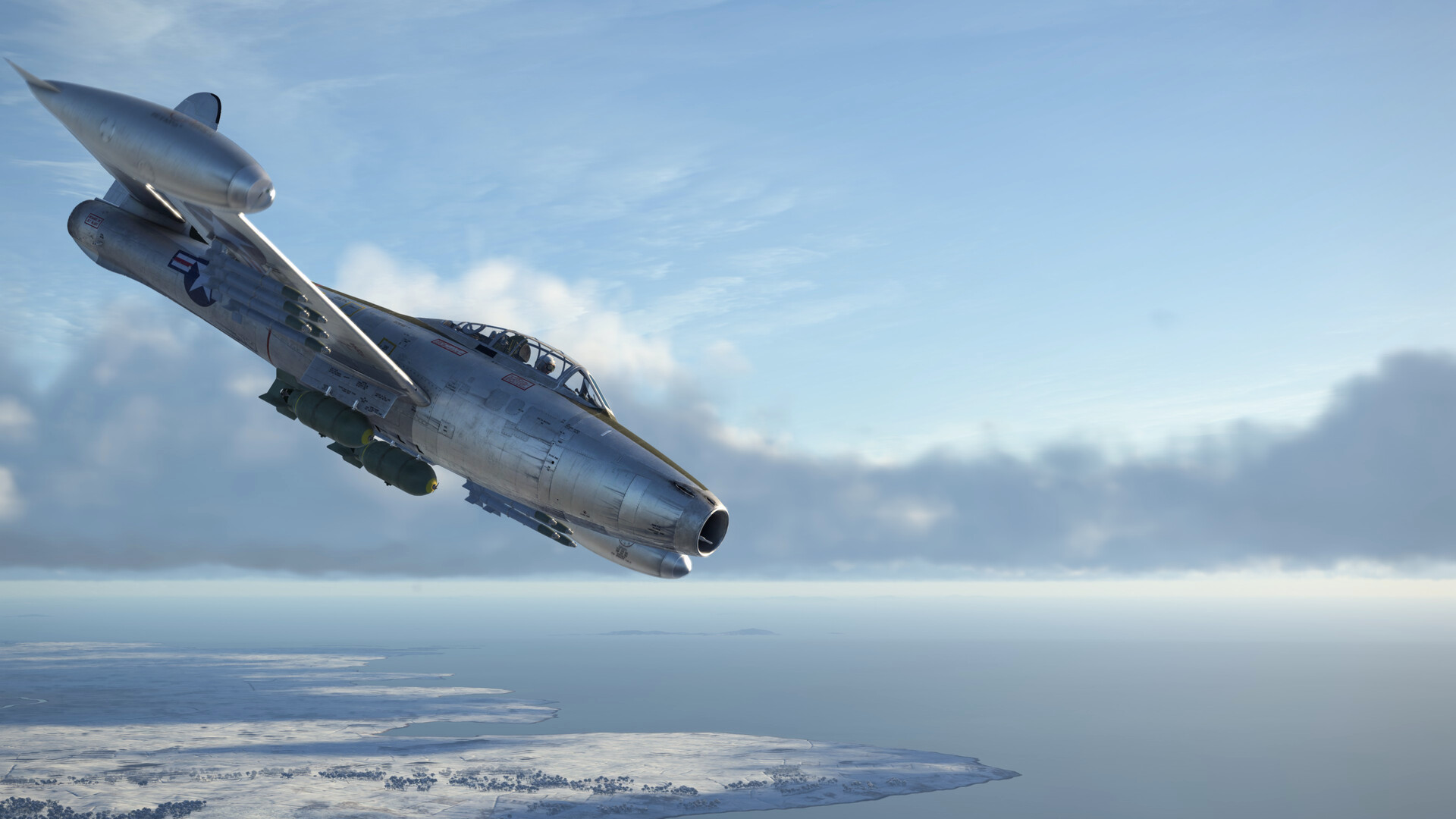
The armament included 6x .50 caliber M3 machine guns. Machine guns were installed as follows: 4 in the nose of the fuselage and 2 in the wing roots. Two bombs of various calibers and rockets could be suspended under the wings. Early F-84E models were equipped with the A-1B sight. During production and modifications, it was replaced with an A-1C sight with an AN/APG-30 radar rangefinder.
Paint Schemes
"Laven". Col. George Laven, Jr., 86th Fighter-Bomber Group Commander, Neubiburg AB, Bavaria, West Germany, 1951.
"SANDY". Captain Warren O'Brien, 9th Fighter-Bomber Squadron, 49th Fighter-Bomber Wing, Korea, 1951.
"Overton". Lt. Dolph Overton, 8th Fighter-Bomber Squadron.